
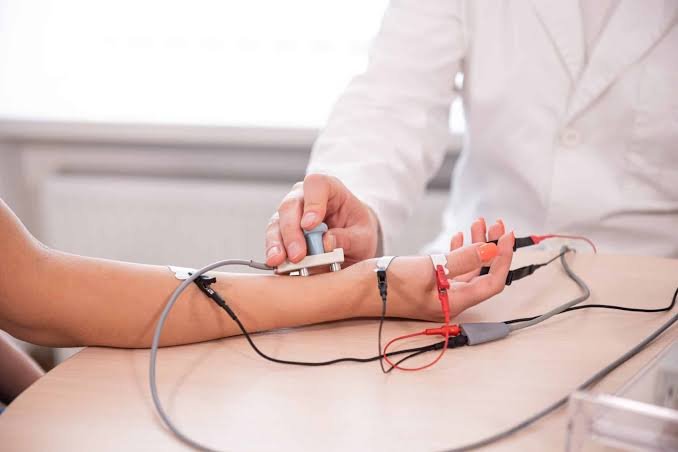
▶ Nerve conduction studies (NCS) give information about how well and how fast the electrical impulses are travelling in the nerves. This test can be used to check for various different types of problems with the peripheral nervous system. The nerve is electrically stimulated and the response of the nerve to that electrical impulse is measured. This is usually done with surface patch electrodes.
▶ NCS is helpful in determining the presence, type, pattern and severity of nerve damage. NCS allows the Neurologist to differentiate between axonopathy (injury to the nerve fibre) and myelinopathy (injury to the protective covering surrounding the nerve fibre).
↪ Dress in loose clothes that permit access to the area to be tested or that are easily removed.
↪ You may need to roll your sleeves up past your elbow and/or your pants up past your knee.
↪ Come with your skin clean and do not apply lotions or creams on your skin.
↪ Eat, sleep and take medications as usual.
↪ Inform if you have a Pacemaker/ICD/DBS type of electrical devices.
✓ of peripheral nerve and muscle problems. This can include peripheral neuropathies, entrapment neuropathies, radiculopathies and muscle disorders.
✓ Neurologists advise them in case patient has tingling, paresthesias, numbness, weakness, muscle pain, radiating pain.
↪ ENMG is very important in certain neurological diseases:
↪ Guillain-Barré syndrome
↪ Carpel Tunnel Syndrome and other entrapment neuropathies
↪ Peripheral neuropathy
↪ Mononeuropathy Multiplex
↪ Motor Neuron Disease/ALS
↪ PIVD/Sciatica/Radiculopathy
↪ Myopathy – polymyositis/dermatomyositis
↪ Muscular Dystrophy
✓ RNS can be useful for diagnosis of neuromuscular junction disorders like myasthenia gravis, Lambert eaton syndrome, Botulism and other such disorders
During a Nerve Conduction Study (NCS), small electrodes are placed on your skin to measure how well and how fast electrical signals travel through your nerves. It may cause mild discomfort but is generally well tolerated.
In a Repetitive Nerve Stimulation (RNS) test, repeated electrical pulses are given to evaluate how your muscles respond over time, helping diagnose conditions like myasthenia gravis. Both tests are non-invasive and usually take 30–60 minutes.
NCS involves small electrical pulses to check your nerve function. You may feel a mild tingling or tapping sensation, but the discomfort is brief and minimal.
No major preparation is needed. However, please avoid applying lotions, oils, or creams on your skin before the test, as they can affect the results. Wear loose, comfortable clothing so the technician can easily access areas being tested.
Test results are usually available within 1 to 2 days and will be discussed during your follow-up appointment with the neurologist.
Discover expert care tailored to you. Schedule your first consultation and begin your journey to better brain and nerve health. We're here to support you—every step of the way.
Personalized care for brain and nervous system health.
WhatsApp us
